No Results Found
The page you requested could not be found. Try refining your search, or use the navigation above to locate the post.

The page you requested could not be found. Try refining your search, or use the navigation above to locate the post.
Der PDCA-Zyklus beschreibt ein vierstufiges Modell zur kontinuierlichen Verbesserung von Prozessen, Strukturen oder Produkten. Die Abkürzung steht für Plan (Planen) – Do (Umsetzen) – Check (Überprüfen) – Act (Handeln). Ziel des Modells ist es, Veränderungen schrittweise und überprüfbar umzusetzen. Ursprünglich im Qualitätsmanagement eingesetzt, wird der PDCA-Zyklus heute in vielen Bereichen genutzt, z. B. in der Organisationsentwicklung, im Projektmanagement oder in Diversity-Strategien. Er ermöglicht es, aus Erfahrungen zu lernen und Prozesse nachhaltig weiterzuentwickeln.
Vereinbaren Sie einen persönlichen Termin.


Senior Consultant
Mathilde Berhault is a senior consultant bei D² – Denkfabrik Diversität. She has professional experience as the managing director of the interculture e.V. association and as a research assistant in international third-party funded projects at the University of Jena. Mathilde brings expertise in intercultural communication, digitalisation and agile management. At D² she specializes in product development and sales of our D² services.
"Diversity in the workplace enables companies and organisations to benefit from a broad spectrum of perspectives, experiences and ideas. I find the opportunity ti think outside the box and utilise different ways of thinking and methods particularly exciting."

Research assistant
Nina Vössing is a research assistant at D² and a student in the Master‘s programme ‘Diversity Management, Religion and Education’. After studying social and environmental sciences in Maastricht (Netherlands), Freiburg (Germany), and Santa Barbara (USA), she explored Berlin‘s social and sustainable start-up scene. Originally motivated to shape a more sustainable economy and society, her focus today lies in the internal social-sustainable structuring of companies and organizations.
“Economic sustainability cannot be realized without diversity. During my studies, I advocated for a sustainable economic transformation. In practice, I realized: If something does not reflect the internal mindset of a company, then it cannot be successfully communicated to the outside world. Diversity-sensitive HR management starts within and promotes resilience, respect and attentiveness – values that are necessary to shape a more sustainable society and economy.”

Creative concept & design
Hannah Baumann is in charge of the creative ideas and their creative realisation at D² – Denkfabrik Diversität. No matter if print or digital - she aims to present the think tank‘s work and content in an attractive way while being accessible to everyone.
After completing her bachelor‘s degree in media design at Hof University of Applied Science, she immersed herself in the world of agency work for three years before joining the Denkfarbik in 2023.
"A very exciting topic for me, where there are no limits. Why not make all information accessible to everyone when all people benefit from an inclusive design? Diversity seems selfevident to many, but on closer inspection it becomes clear how much we can still do to actually achieve it. This design challange is an exciting journey for me!
CEO
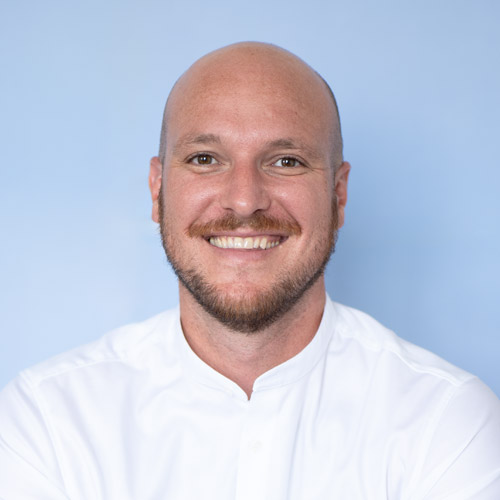
Dr. Julien is a diversity manager, PR consultant and co-founder of D² – Denkfabrik Diversität. His expertise include the topic of antiracism, approaches to adult education and the development of communication strategies. After studying cultural studies and completing his doctorate ate the University of Würzburg, he taught and conducted research at the universities of Jena, Passau, Fulda, Edmonton (Canada), Dakar (Senegal) and Kinshasa (Democratic Republic of Congo), among others. His academic specialisations include Postcolonial Theory & Critical Race Studies, Intercultural Communication and Diversity Management within the police force and security agencies.
What does diversity mean to you?
"Diversity is based on mutual understanding, which can only develop through respectful dialogue. As a white cis man with migratory history, it means one thing above all for me: listening to others. It is extremely important to me to recognize different perspectives and to question my own privileges with a lot of self-reflection."
CEO
Catharina Crasser is Diversity manager at D² – Denkfabrik Diversität. Her expertise include contemporary diversity research with a focus on gender and intersectional diversity concepts. After completing her Bachelor‘s degree in Political and Social Sciences, she obtained a Master‘s degree in 'Diversity Management, Religion and Education‘ at the University of Würzburg. Alongside her work at D², she teaches various seminars in this Master‘s.
"I enjoy enjoy introducing the topic to people in so many different ways. The exciting part is to find success with ideas and methods in some places and to fail miserably with a similar idea in other places. Above all, it‘s about understanding different perspectives and needs and creatively developing suitable concepts."

Initiator and CFO
Andreas Möller is an entrepreneur, initiator and co-founder of D² – Denkfabrik Diversität. His expertise include the areas entrepreneurship, corporate leadership and inclusive HR management. After more than ten years of self-employment, he now runs one of Europe‘s fastest-growing medium-sized companies. As a coach and consultant, Andreas enthusiastically passes on his experience to clients from a range of sectors.
"Thanks to my many years of experience as an entrepreneur and employer, I am familiar with the diverse challanges of our business world. I am convinced that great success can be achieved with inclusive strategies and holistic diversity management. And I want to share this vision with other entrepreneurs."